Nash didn’t Hallucinate, he Compensated — A Beautiful Mind
A Beautiful Mind shows how Nash used imagination as both support and sabotage, and how logic plus love became his way back to reality.
Let me start with the Pentagon scene that forced me into Nash’s shoes as a viewer. For a long time, I wondered whether he actually went to the Pentagon or if that was an imaginative scene straight from his mind. That was the setup where he first witnessed Parcher.
Was Parcher an imagined figure in an imagined setup, or was the setup at least real? The film didn’t just show me Nash’s confusion. It briefly gave it to me.
The Scaffold
Nash was a mathematician who communicated in math small-talk only. Not many got him, which he accepted many times, which points to his lack of belonging & poor social confidence.
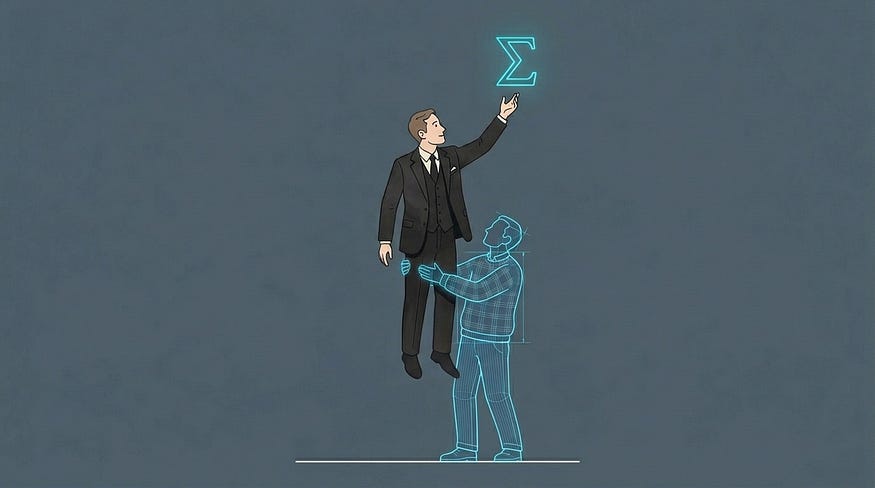
Hence, his beautiful mind engineered the perfect friend, Charles. One of the most productive imaginations John could’ve conjured. He called the confident Charles his prodigal roommate.
Why productive? First, understand Vygotsky’s scaffolding concept (Mental Model) — One needs an external support structure to cross beyond one's current capability. When Nash was alone, Charles was the scaffolding that ultimately led him to win the Nobel Prize.
The Double-Edged Sword
Belonging was in check now, our hero got placed into Wheeler’s Lab at MIT. He now needs a mission to use his cryptographic skills. Therefore, he uses the same function in his head, but the output differs this time.
Enters, William Parcher, a secret defence agent who provides Nash the opportunity to work in confidential matters of national security. However, this aberrant output started perniciously persecuting John. Giving him threats to assassinate his wife to preserve the confidentiality of his chores.
His imagination supplemented (Charles) as well as degenerated (Parcher) his growth, hence the title is justified.
The Mathematician’s Loophole
Schizophrenia is a mental disorder characterized variously by hallucinations, delusions & disorganized thinking or behavior.
Our mathematician was suffering; his cognitive ability to tell the difference between reality and imagination was decaying. It reached its peak when Alicia (his spouse) took their baby and went out to run away from him.
All three hallucinated figures showed up and started calling out for John aggressively in his mind. Eureka! The Beautiful Mind leveraged its innate skill, Mathematical logic, to deduce that Marcee (3rd figure — young girl) never aged, therefore she is fake.
Why was Nash eschewing logic earlier then? A classic example of Motivated reasoning — one unconsciously protects beliefs that serve oneself.
That day, his pattern recognition skills saved his marriage.
This whole scene gave rise to my wish that maybe Nash would cure his Schizophrenia through some mathematical discovery rather than medical treatment. Think how awesome it would be if he discovered some logical constraints to curb his hallucinations?
Then again, you cannot audit a system from inside. His mind engineered these figures precisely to suit his needs. Had he put a math filter on, some random figure might have come up who was immune to those variables.
So my wish is just fantastical.
The only real anchor, Alicia
I’ve never seen such a heroic female character in any movie. Her grit, love, and loyalty for Nash were so strong. She provided a real scaffolding which helped John break his motivated reasoning towards his hallucinations.
She handled the baby, became the main bread earner, and aided his husband’s schizophrenia treatment. Nash secretly stopped taking meds for her fulfilment even though he wanted his functional self back.
Great example of opportunity cost, he chose relational self over his functional self. However, Alicia deserved it, and she kept his legs in reality at all times.

The Sapiens move & Survivorship bias
As mentioned in the book Sapiens, during the cognitive revolution, humans attained the power of imagination — the ability to believe in non-existent things. Social beings like us draw imagination outwards (money, religion); however, Nash, deprived of the social lens, used it inwards (Charles, Marcee, & Parcher).
Nash leveraged his imagination & pragmatic approach towards an authentic theory. However, that is not the secret success formula, because think about those whose private scaffolding collapsed, and they produced nothing, but we don’t have movies for them.
Only diamonds say, “Diamonds are formed under pressure.” Like the “Money doesn’t matter” for the rich.